Survey the loaded route rather than looking only at yard area
A large yard can still have a difficult turning point beside a container, a ramp, a drainage channel or a crossing with lorries. Draw the route from the collection point to the load's destination and mark the narrowest point, blind corners and waiting positions. Record when goods accumulate as well, because an open area in the morning may become a narrow corridor when several lorries arrive together.
Describe the surface as it actually is: level or edged, with any subsidence or standing water, and with any transitions between different surfaces. A diesel forklift is not automatically an all-terrain truck. Capabilities such as gradeability or ground clearance in the documentation must be read under the conditions specified for the model; one figure should not be used to approve travel over every part of the route.
Match capacity to the load type and attachment
Building materials, steel bundles and palletised goods create different access requirements. The assessment depends on the weight including packaging, the load dimensions and its centre of gravity. If a clamp, bucket or rotator is used, evaluate the complete combination with the truck rather than treating nominal capacity as the capacity of the whole system.
The purchase brief should contain a separate item for long or non-standard loads. Record the current handling method and its difficulties instead of selecting longer forks yourself and assuming the problem is solved. Changing forks or fitting an attachment can alter load conditions, visibility and turning space. The technical provider should confirm an appropriate solution before it is used as the basis for the quotation and acceptance testing.
Comparison checklist for the purchasing team
| Yard condition | Survey information | Related configuration or action |
|---|---|---|
| Surface and transitions | Edges, channels, gradients and damaged areas | Compare the model and tyres; improve the route |
| Loads | Weight, dimensions and centre of gravity | Capacity for the configuration and attachment |
| Environment | Indoor and outdoor areas | Assess fuel-type suitability |
| Flow | Lorries, peak periods and waiting | Whole-route productivity and service plan |
The tyre type must suit the surface and use conditions
Compare tyres for the exact configuration, surface and manufacturer's instructions. Do not assume that solid or pneumatic tyres are better in every case. The buyer should ask which type is being offered, how it affects working conditions, how it can be replaced and which inspections are required. Product photographs assist identification but do not replace a configuration schedule.
If the yard contains metal fragments, sharp objects or surface edges, changing the tyre is not the only measure. Cleaning, surface repairs and route organisation also affect operating stability. Include the yard conditions that must be improved in the commissioning plan. Correctly configured equipment can still perform poorly when it repeatedly avoids obstacles or waits for a crossing to be cleared.
Consider exhaust emissions, noise and indoor areas
If part of the route passes through a workshop or enclosed warehouse, assess the working environment with a competent person. The fact that the truck fits through a doorway does not prove it is suitable for that area. The selection must consider ventilation, worker exposure and requirements specific to the goods or production process.
Likewise, do not choose the fuel type merely because the previous equipment used it. A factory may benefit from a routed fleet, with one type of equipment for the yard and another for the warehouse. Compare that approach against the workload and the number of pallet transfers. If one truck is intended to serve both areas, request a clear assessment of the limiting conditions instead of relying on the general description that it can be used both indoors and outdoors.
Estimate operating costs with verifiable data
Record fuel use for a defined period together with the corresponding output rather than asking only for theoretical consumption. Maintenance schedules should follow the documentation and the truck's working conditions; do not set one general interval for every model. In the estimate, separate consumables, labour, parts and items that may fall outside the offered service scope.
For a yard receiving goods at fixed times, downtime costs can arise from queued goods and waiting lorries. Describe the operating plan for periods when the principal truck is undergoing maintenance, including how throughput will be rescheduled. There is no need to buy a standby truck automatically without analysis, but the risk should not be ignored simply because average utilisation over the whole day appears low.
Confirm handover against the route that was surveyed
The schedule should state the model, mast, forks or attachment, tyres and options required for the environment. Acceptance criteria should relate to the confirmed work, within technical limits and safe test conditions. Identify the matters that cannot be assessed in a short trial, such as actual weekly fuel consumption or operation during the peak season.
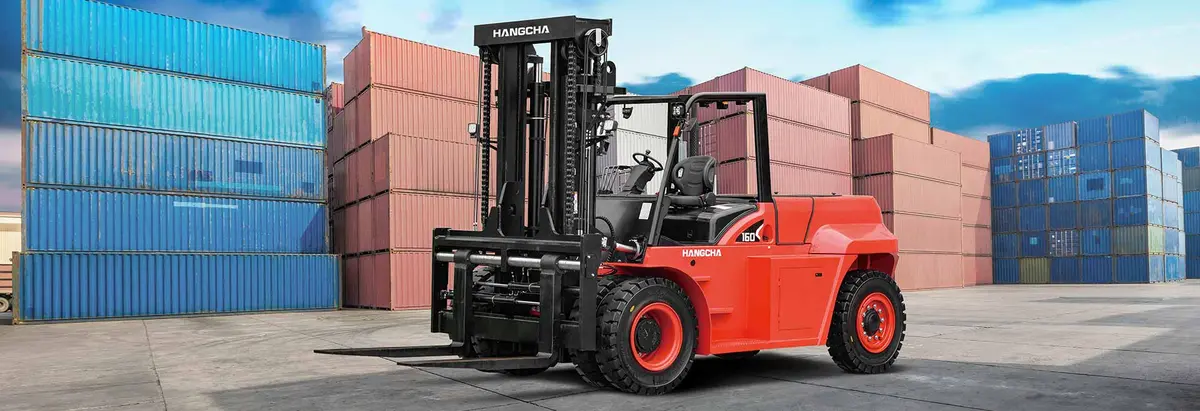
ACE C&T lists Hangcha diesel forklift ranges for reference. The purchase price, supply schedule, handover documents and support conditions are confirmed for each order; immediate delivery or free maintenance is not assumed. When submitting an enquiry, photographs of the actual route and loads usually support a more productive discussion than stating only that a three-tonne diesel truck is needed for a yard.
Frequently asked questions
Can a diesel forklift automatically travel over every yard surface?
No. The route, surface, gradients and model conditions must be compared; the fuel type does not determine all-terrain capability.
Can a diesel forklift be used in every enclosed warehouse?
This must not be assumed. Suitability for the environment should be assessed by the appropriate department and a competent person for the actual work.
NEW HANGCHA FORKLIFTS · CONFIGURED FOR YOUR WORK
Send your forklift purchase requirements to ACE C&T
Send the actual load, pallet dimensions, rack height, aisle width, shift schedule and operating location. Purchase price, supply timing, warranty and service are confirmed in each quotation or contract.
Mr. Lê Đình Lê · 0904.070.313 · ledinhle@live.com
Depot: Tu Son, Bac Ninh · Office: Hanoi · Nationwide supply in Vietnam.
Reference sources: Hangcha — lithium truck range. OSHA documents are cited as international technical references and do not replace requirements applicable in Vietnam. ACE C&T prepared the assessment framework, hypothetical scenarios and calculation examples; operating specifications must be confirmed for the actual equipment.