Treat the carton as part of the load handling system
Record the contents, external dimensions, weight, number of carton layers, packing inserts, and how the package is assembled. Two cartons with the same external dimensions can react differently to pressure on their sides. Get the data or ask for confirmation from the packaging design team. Pressing on the carton by hand does not establish what it can withstand. For household appliances, also record the required orientation and any areas where pressure must not be applied, as specified in the product documentation.
Include typical loads, heavy loads, and loads with sensitive packaging in the sample list. Record storage conditions and the actual condition on receipt, especially when new batches differ from stock that has already been stored. For example, a factory might change carton suppliers while keeping the same finished product SKU. That change still calls for a review of the clamping method. An unchanged SKU does not establish that all handling conditions are unchanged.
Check the load arrangement, contact surfaces, and route clearances
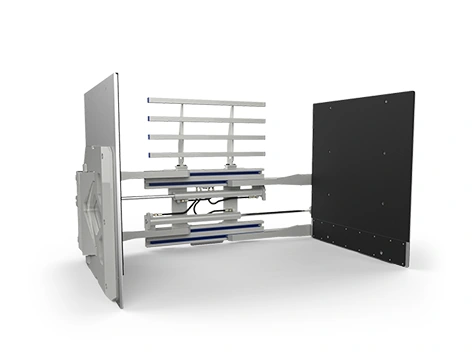
Describe whether cartons are clamped individually or in groups, how many rows are used, and which faces point toward the clamp arms. Ask the supplier to identify the opening range, contact pad dimensions, and configuration suitable for each group you listed. Do not add cartons simply because there is space between the arms. Assess each arrangement as a separate load configuration because the contact points and weight distribution can change.
Survey the gaps between cartons in the staging area, door widths, where the forklift needs to turn, and how the load will be placed on the floor or onto the receiving vehicle. A clamp that fits an individual carton may not work with the warehouse's current tightly spaced layout. Include a simple sketch of the pickup and placement points in the requirements. This lets you discuss changes to the staging layout and equipment together and catch clearance problems before the forklift arrives at the factory.
Selection comparison
| Task | What the factory prepares | What to record |
|---|---|---|
| Identify the loads | Specifications, weight, packaging, and orientation | Sample list and any loads not yet assessed |
| Approve contact areas | Permitted clamping areas and product requirements | Confirmed contact pads, opening range, and load arrangement |
| Assess quality | Criteria, sampling method, and checks after handling | Condition of the carton exterior and quality inspection results |
| Define the commercial scope | Throughput, required term, and packaging change plans | Purchase or rental options that specify who is responsible for checks |
Verify clamp force control in a trial overseen by the quality team
Carton clamp manufacturers offer force control options for specific applications. Ask which option the proposed model uses, what its limits are, and what checks it requires. Do not apply a single pressure setting to all carton types or accept a setup solely because the load did not fall. The configuration must both retain the load within its design limits and meet the quality criteria set by the business.
Plan how to inspect the outside and inside of the package under the factory's procedures. Damage to some products only shows up when the carton is opened or at a later stage, so the quality team needs to decide how to sample and when to inspect. The trial record should identify the goods, packaging, approved configuration, and results against those criteria. Do not ask operators to increase the force from one attempt to the next to find a setting that seems to work.
Approve the forklift and clamp as one complete configuration
Ask the technical team to verify the lifting capacity of the combined setup at the intended load center and lift height, with the planned carton arrangement. Have them confirm the clamp model, mast, and carriage interface. Record the attachment's weight and how far it projects forward. The capacity marked on a clamp does not establish the allowable load for every forklift. Configuration approval must apply to the specific forklift and the job it will do.
Check the hydraulic pressure, flow rate, number of functions, controls, hydraulic lines, and clearances against the documentation for the selected equipment. Record the visibility requirements and operating instructions for switching from pallet forks to clamp arms. A capacity determination or handover procedure from the previous setup cannot be carried over as written to accept the new configuration. A qualified provider must install and check the equipment before handing it over to the user.
Measure the effect on shipping cycle time and rework rates
The trial plan should cover picking up cartons, traveling along the surveyed route, setting down the load, and checking quality. Run the trial only under conditions approved by the technical team and with an operator who has received suitable instruction. Record waiting time, the number of times loads have to be repositioned, and the number of cartons that need additional inspection. These results show where the clamp improves the flow of goods beyond the time it takes to pick up a load.
For example, removing the pallet might eliminate one handling step but require a new stacking pattern at dispatch. Include any new work at dispatch, at receiving, and in quality inspection alongside forklift time. If a trial sample fails the packaging criteria, record which configurations or groups of goods were not approved. Do not apply results for one type of carton to the full product range while other products remain unverified.
Compare purchase and rental options and plan for packaging changes
Stable demand, infrequent packaging changes, and consistent throughput are useful inputs when evaluating a purchase. A packaging trial or a production ramp-up may also warrant comparing rental options if a suitable forklift and clamp are available. Use the same list of loads and trial conditions for both options, and specify who will reassess the configuration if the packaging changes. Agree in advance whether the equipment can be used for different loads.
Sales and rental quotes should specify the forklift, clamp, contact pads, force control option, installation, transport, checks, and handover. An equipment purchase price and a periodic rental charge cover different things, so compare what each quote includes. ACE C&T reviews your requirements and advises on Hangcha forklifts for your application. The available configurations, trial conditions, and scope of service are confirmed for each request.
Frequently asked questions
Is a thick carton always suitable for a clamp?
Visible thickness alone cannot establish suitability. Review the packaging construction, product, packing inserts, contact areas, and stacking pattern. The packaging or quality team must help confirm the criteria and assess the trial samples.
Should we review the clamp setup if we change packaging suppliers?
Include the supplier change in the factory's assessment process. Confirm whether the new cartons are still within the scope of the trial and approval. The same product SKU or external dimensions alone do not establish that they are.
HANGCHA · ACE C&T
Hangcha forklift sales and rental for your operation
Send load photos, weight, dimensions, placement height and your existing truck model to compare purchase and rental options. Compatibility, availability, prices and service scope are confirmed in each quotation.
Mr. Lê Đình Lê · 0904.070.313 · ledinhle@live.com
Technical references: Cascade — carton clamps and force control options · Bolzoni Auramo — carton clamps and force control by application · Cascade J-Series — truck requirements, hydraulics and approved combination capacity. The evaluation framework and hypothetical examples are prepared by ACE C&T. Each manufacturer document applies to the equipment it describes; the truck and attachment combination requires separate confirmation. This guide supports equipment selection. Installation, settings, load testing and operation must follow the approved documentation and instructions for the specific equipment.