Identify the full roll range and the condition of paper in the warehouse
Prepare a table of the minimum and maximum diameter, height, weight and receiving orientation for each group of rolls. Record the packaging type, surface condition, permitted contact areas and edge-protection requirements using the factory's data. Do not use an average roll to represent the entire throughput. An infrequently handled specification with a very small diameter or a sensitive surface may determine the need for a separate handling solution.
Distinguish between collecting rolls from the floor, receiving them from a truck, moving them into storage and feeding them into a machine. Each point has different clearances, approach directions and orientation requirements. In a hypothetical example, a factory receives upright rolls but one process requires them to be laid horizontally; the brief must specify this change of orientation rather than simply request a paper clamp. If the data is incomplete, clearly identify the specifications awaiting confirmation and exclude them from the committed scope for now.
Select clamp arm geometry and contact surfaces using actual rolls
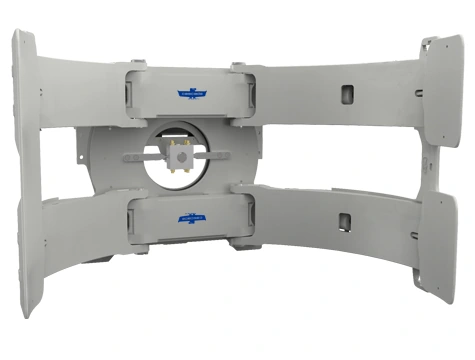
Compare roll dimensions with the arm opening range, arm geometry and contact surfaces of the exact clamp model. Some designs offer different arm and contact-surface options for specific work; this does not mean that every roll clamp can handle the same load range. Ask the supplier to identify the proposed contact positions on the roll specifications in the brief, along with any cases requiring a configuration change or exclusion.
When inspecting samples, involve the quality team in defining unacceptable signs: pressure marks, scratches, damaged edges or changes in shape that affect a later process. These limits must be set by the organisation responsible for the product, rather than applying one general criterion to all paper types. Photograph rolls before and after from the same angle, recording the batch code and packaging condition. A systematic photographic record is more useful than a subjective impression after a trial move.
Selection comparison
| Item | Information to prepare | Confirmation required |
|---|---|---|
| Roll specifications | Diameter, height, weight and orientation | Working range of the exact clamp model |
| Product quality | Packaging, contact areas and unacceptable signs | Contact surfaces and trial criteria with a designated owner |
| Equipment combination | Truck, mast, clamp, height and load centre | Approved capacity and working orientations |
| Transfer scope | Collection and placement points, routes and orientation changes | Cycle-based trials and a record of what remains unverified |
Assess clamping force as part of the application trial
Clamping force must suit both the goods and the equipment: insufficient force may fail to hold the roll, while unsuitable force may damage the product. Force-control solutions depend on the design of each model. Do not use a pressure figure passed on informally for every paper roll, or treat hydraulic pressure as a guarantee of load quality. Selection, inspection and adjustment must follow the manufacturer's documentation and be carried out by a competent provider.
In the trial plan, separate load data from equipment data. The factory provides specifications, weights, packaging requirements and quality criteria; the technical team confirms the configuration and permitted trial conditions. Record what has been confirmed rather than asking the operator to make adjustments through repeated attempts. If the paper type, packaging or diameter range changes, review the conclusions of the previous trial before using the same settings.
Check the truck, mast and clamp in the required working orientations
The clamp has its own weight, effective thickness and centre of gravity. The position of the roll's centre of gravity also changes with its orientation. The technical provider must check the brief against the capacity of the truck, mast and clamp combination at the approved height, load centre and orientation. Neither the truck's nominal capacity nor the capacity marked separately on the clamp establishes the capability of the complete combination.
Confirm the carriage interface, hydraulic lines, pressure, flow, controls and clearances for the exact configuration. Survey doorways, turning points, visibility and approach clearances along the warehouse route. If the clamp has a rotation function, request an assessment of its full range of movement at the intended location. Do not assume that fitting the attachment establishes that the configuration is suitable for every operation in the factory.
Base acceptance on the roll's journey through the factory
Select representative sample batches agreed by the factory and technical provider, use an appropriately instructed operator and remain within the confirmed limits. The trial record should state the collection and placement points, roll orientation, number of trial cycles and post-trial assessment method. Do not use the trial to discover limits by increasing loads or force beyond the instructions. Mark any specifications that have not been tested so they are not assumed to have been approved with the rest of the group.
Alongside time, record the condition of the rolls, ease of observation, the number of direction changes required and any additional work after transfer. In a hypothetical example, the way rolls are arranged requires the clamp to change direction in a tight warehouse corner; changing the staging position may be useful before considering another attachment. Trial results should lead to a specific decision: accept the configuration, request adjustments, carry out a further survey or use a different handling solution for a particular roll group.
Compare purchase and hire for regular and occasional roll requirements
For a stable roll range, consistent throughput and a long-term usage plan, a business can assess purchasing a standardised combination. When taking on a new paper project or temporarily increasing production, hire may be an option to consider if a suitable configuration is confirmed. Compare purchase and hire using the same roll range, duration, work schedule, quality level and service scope, rather than comparing equipment charges alone.
Request a quotation that itemises the truck, clamp, contact surfaces, controls, installation, transport, application trial and handover documentation. Clarify responsibilities when roll specifications change during use; do not assume that the original configuration covers every future batch. ACE C&T provides advice on sales and rental of Hangcha forklifts for the work involved. Prices, available configurations and support conditions must be confirmed for each specific brief.
Frequently asked questions
Can one roll clamp handle every type of paper?
That cannot be assumed. The roll range, weight, orientation, packaging, contact areas and quality requirements must be checked against the exact model. When specifications change, warehouse and technical teams need to review the scope that has been confirmed.
Can I hire a roll-clamp forklift to trial a new project?
You can request a hire option based on the project brief, but the availability of a suitable configuration, trial conditions, duration and service scope must be confirmed. Hire does not replace checking combined capacity, clamp compatibility and paper quality criteria before use.
HANGCHA · ACE C&T
Hangcha forklift sales and rental for your operation
Send load photos, weight, dimensions, placement height and your existing truck model to compare purchase and rental options. Compatibility, availability, prices and service scope are confirmed in each quotation.
Mr. Lê Đình Lê · 0904.070.313 · ledinhle@live.com
Technical references: Bolzoni — roll clamp configurations and contact-surface options · Cascade — paper roll clamp guide and combined truck/attachment capacity · Cascade — 22H and 24H paper roll clamp family. The evaluation framework and hypothetical examples are prepared by ACE C&T. Each manufacturer document applies to the equipment it describes; the truck and attachment combination requires separate confirmation. This guide supports equipment selection. Installation, settings, load testing and operation must follow the approved documentation and instructions for the specific equipment.