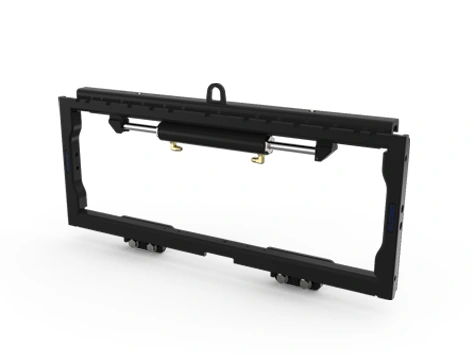
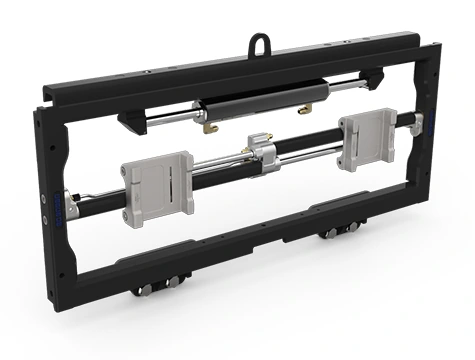
A sideshifter moves the complete fork assembly; a fork positioner changes fork spacing
A sideshifter moves the complete fork assembly and the load it supports to the left or right within its designed travel. A fork positioner allows the distance between the two forks to be adjusted to match a pallet's fork entry openings. A configuration may integrate both functions, but this must be stated clearly in the documentation and quotation. The ability to change fork spacing does not automatically establish that the attachment also has a function for shifting both forks sideways together, or that it suits every pallet in the warehouse.
Describe the difficulty you are experiencing: does the truck need to approach repeatedly to place a pallet in a rack bay, or does the operator frequently leave the cab to adjust fork spacing when switching between pallet groups? The first situation calls for a survey of the placement locations and lateral alignment requirements; the second calls for checking the fork opening range. If both apply, request a quotation for a combined configuration and identify the data that makes it necessary. Asking about specific situations provides a stronger basis for selection than adding options out of habit.
List pallets and placement locations before choosing a working range
For each pallet group, record the external dimensions, clear dimensions of the fork entry openings, ground clearance, entry direction and total weight including the goods. Also record the actual condition of the pallets, because warped or cracked pallets may produce different results from new samples. Measurements should be taken at the receiving and delivery points, rather than relying solely on pallet purchasing drawings. If the warehouse uses several packaging suppliers, keep an identification table of the specifications currently approved for the truck's working route.
At the racks, record bay widths, obstructions, placement depths and approach directions. Sideshift travel cannot compensate for insufficient aisle space or an unsuitable rack layout. In a hypothetical example, a warehouse receives two pallet groups with different fork entry spacing and places them in separate areas. Before choosing a fork positioner, it could compare assigning trucks to each area with using one truck to serve both. Either option needs to be tested on the actual route that has been surveyed.
Selection comparison
| Situation | Function to consider | Evidence required |
|---|---|---|
| Aligning the entire pallet from side to side | Sideshift | Suitable travel and a trial at the placement location |
| Switching between different pallet fork entry specifications | Fork positioning | Opening range, fork dimensions and actual pallet samples |
| Both lateral alignment and fork spacing adjustment | A confirmed combined configuration | Documentation of functions, controls and combined truck/attachment capacity |
| Holding a load with pressure from both sides | A dedicated clamp suited to the goods | Approval of the clamping function and a load quality trial |
Check combined capacity and changes to the dimensions at the front of the truck
Do not approve a configuration simply by comparing the sideshifter's capacity with the capacity figure in the truck's model name. The attachment has its own weight, thickness and limits; the combination also depends on the mast, load centre and working height. Ask the supplier to confirm the lifting capacity for the exact truck and attachment configuration and provide the corresponding capacity documentation. Do not treat the truck's capacity minus the attachment's weight as the permitted lifting capacity.
Also check the working length, overall width, visibility and clearance from the mast. If modifying an existing truck, provide its model, identification number and mast details rather than simply stating its tonnage. Keep the current fork configuration, fork length and actual load data in the file. When changing fork types or adding a function, ask the technical team to reassess the combination rather than carrying over the conclusions for the previous configuration.
Do not use an ordinary fork positioner to grip loads by squeezing them
Fork positioning is a function for setting the forks' positions. The fact that two forks can close towards each other does not turn an ordinary fork positioner into a clamp designed to grip a load. If the task requires gripping a load, consider equipment with a manufacturer-approved clamping function and contact surfaces suited to the goods. State this distinction clearly in the technical requirements so that quotation reviewers do not select the wrong option simply because the commercial names sound similar.
The control documentation and handover instructions must also reflect the correct functions. The warehouse should agree on a list of tasks permitted for the configuration, such as supporting pallets of the specifications that have been tested, rather than leaving users to infer its capabilities from the movement of the forks. When a non-palletised load appears, treat it as a new requirement that needs assessment. Do not experiment by increasing pressure or adding your own clamping surfaces to extend the function beyond its design.
Document the pallet changeover and positioning trial clearly
The trial should include representative samples from each pallet group, surveyed pickup points and placement bays, and the limits confirmed by the technical team. The warehouse supervisor should record the number of repeated approaches, the time needed to switch between pallet groups and any tasks that cannot be completed. Operators need instruction in line with the equipment documentation; this advisory article does not replace training or checks of the conditions of use at the plant.
Do not measure only how quickly the unloaded attachment moves. Assess the benefit across the pickup, travel, placement and return cycle while also monitoring the condition of the pallets and goods. In a hypothetical example, a combined attachment makes switching pallet specifications more convenient, but waiting at a doorway still accounts for most of the cycle. That result shows that goods flow needs improvement alongside equipment selection. Record the points that have not met the requirements as well, so that the supplier can revise the proposal before signing.
Compare purchase, hire and the scope of installation side by side
When comparing purchase and hire, use the same pallet list, working load, mast configuration and evaluation period. A need to switch pallet types continuously over several years differs from a single project delivery period. You can request an option to purchase the complete truck and attachment combination and an option to hire for a trial period, then compare the full scope rather than looking only at the attachment's unit price. Hire terms and the right to change the configuration must be confirmed in the specific proposal.
The quotation should itemise the attachment, any included forks, hydraulic lines, controls, installation, configuration checks and documentation handover. For an existing truck, clarify who is responsible for assessing compatibility. ACE C&T accepts application details to advise on sales and rental of Hangcha forklifts for the work involved. The choice of a sideshifter, fork positioner or combined attachment is confirmed for the exact model, rather than assuming that every truck can accept the same type.
Frequently asked questions
If I have a fork positioner, do I still need a sideshifter?
It depends on the task and the attachment's design. A fork positioner changes fork spacing; a sideshifter aligns the complete fork assembly laterally. If the quotation specifies a combined configuration, request documentation confirming both functions and test it with the actual pallets and placement locations.
Can a sideshifter be retrofitted to a truck I already own?
The truck model, mast, fork carriage, hydraulics, controls, clearances and combined truck/attachment capacity after installation all need to be checked for the specific configuration. Send the truck details and pallet records to the technical team; do not decide solely on nominal capacity or external appearance.
HANGCHA · ACE C&T
Hangcha forklift sales and rental for your operation
Send load photos, weight, dimensions, placement height and your existing truck model to compare purchase and rental options. Compatibility, availability, prices and service scope are confirmed in each quotation.
Mr. Lê Đình Lê · 0904.070.313 · ledinhle@live.com
Technical references: Cascade — sideshifter function · Cascade — fork positioner function · Cascade — fork positioner instructions and limits. The evaluation framework and hypothetical examples are prepared by ACE C&T. Each manufacturer document applies to the equipment it describes; the truck and attachment combination requires separate confirmation. This guide supports equipment selection. Installation, settings, load testing and operation must follow the approved documentation and instructions for the specific equipment.