Define the discharge task and the containers to be used
Record the material inside, the total weight of the full container, its external dimensions, the centre of gravity and how it is picked up. Information about the base geometry, fork pockets where fitted, the container opening and the permitted retention points must be supplied or confirmed by the container owner. Photograph the container both empty and in its normal working condition. A single front-view photograph is not enough to assess how the container is supported and retained as its orientation changes.
Distinguish between moving a closed container, reorienting it to feed material and discharging it into receiving equipment. Each task has different requirements for positioning, clearance and material control. As a hypothetical example, a workshop may use containers of the same dimensions for two materials, but one material may shift unevenly; that characteristic needs to be communicated to the technical team instead of treating the two tasks as identical. Any special material properties must be assessed by the factory's relevant specialists before the application is finalised.
Use a retention mechanism suited to the design, without improvised substitutes
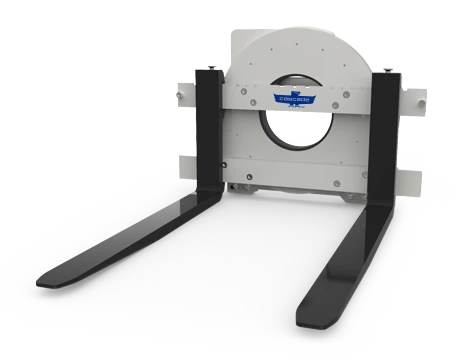
Some rotator configurations offer dedicated container retention mechanisms; the appropriate type depends on the specific container and application. Request documentation that identifies the retention method and the range of approved containers. The fact that the forks fit underneath a container does not establish that the container can be rotated. Do not add improvised straps, weld on retaining pins or combine a different retention mechanism with the equipment to make an unsuitable configuration appear usable.
The requirements brief should identify technical representatives for both the equipment and the container. Specify who will inspect existing containers, who will confirm the retention mechanism and which changes must be reported. If a container is repaired, its construction material is changed or its shape is altered, treat this as a configuration change requiring assessment. This approach helps businesses avoid relying on a container sample tested long ago that no longer represents the containers circulating through the workshop.
Selection comparison
| Area | Input data | Required outcome |
|---|---|---|
| Container and material | Full and empty containers, weight, geometry and material properties | Approved range of containers and applications |
| Retention method | Fork pockets, permitted contact points and container documentation | Confirmation of a retention mechanism suited to the design |
| Truck combination | Truck, mast, rotator, hydraulics, height and load centre | Capacity and configuration compatibility documentation |
| Discharge point and handover | Area layout, receiving equipment and trial samples | A record against each criterion, identifying anything not tested |
Check the capacity and movement of the complete combination
The truck manufacturer is responsible for determining the capacity of the approved combination; this may differ from the capacity stated separately for the rotator. The documentation must identify the truck, mast, rotator, forks or retention mechanism, full container weight, load centre and working height. Request capacity documentation for the intended application instead of inferring it from the nominal figure in the truck's model name or subtracting the attachment's weight.
Also check the required movements, clearance between the attachment and mast, carriage interface, hydraulic lines, pressure, flow and controls. A combination with an additional hydraulic retention function may have its own requirements; information must be obtained for the exact model. A successful fit on another truck is not evidence of suitability for the truck in use. The installer must confirm the documentation and carry out checks before proceeding to an application trial at the factory. The technical team must also compare the load’s rotational torque requirements with the limits of the exact rotator using the manufacturer’s documentation; adequate lifting capacity does not replace this check.
Survey both the container pickup area and the space where material leaves the container
Measure the approach, doorways, obstructions, receiving opening height and clearance around the proposed reorientation point. Consider both the container and the projecting parts of the attachment throughout the approved range of movement. Bring a drawing of the receiving equipment and a plan for pedestrian routing to the site survey. These details help the technical team assess the complete task; a rotator cannot resolve an overly confined discharge point or an inadequately organised flow of people.
The factory must clarify how material will be received, how residue inside the container will be handled and how cleaning after each shift will be carried out under its own procedures. As a hypothetical example, the wait for a receiving conveyor may exceed the time needed to change containers; in that case, assess coordination between process stages before buying more equipment. This guidance focuses on configuration selection and does not provide a container rotation procedure to replace equipment documentation, site assessment or operator instructions.
Define a trial record with clear pass or fail criteria
Prepare sample containers and materials approved by all parties, together with a specific trial scope. Operators must receive appropriate instruction and work within the confirmed technical conditions. Warehouse staff record container pickup and return, the technical team checks the combination, and the person responsible for the receiving process assesses its ability to accept the material. Do not use the trial to explore limits by increasing the load or testing unapproved orientations.
Criteria may include compliant containers being picked up and returned to the correct positions, a retention mechanism that matches the documentation, no unexpected difficulties at the receiving stage and a cycle time that meets the agreed plan. Record results for each sample container rather than simply stating that the truck runs well. If any criterion is not met, identify the data or configuration that needs to be reviewed before deciding whether to purchase, rent or reorganise the process.
Compare purchase and rental for a combination confirmed as suitable
Where the work recurs regularly and containers are standardised, assess purchase alongside a plan for managing the equipment, containers and spare parts. For a process trial or a short project, also ask about rental options if a suitable combination can meet the requirements. Purchase and rental comparisons must use the same data on containers, materials, frequency, duration and responsibilities. Do not choose an option that looks cheaper on paper while omitting the retention mechanism or installation.
Request an itemised quotation covering the truck, rotator, forks or retention mechanism, hydraulic lines, controls, installation, transport and handover inspection. Clarify what must be reconfirmed if containers or materials change. ACE C&T accepts application briefs for Hangcha forklift sales and rental. Prices, attachment availability and the scope of support will be confirmed separately; do not assume that every truck model can use the same rotator.
Frequently asked questions
Can a container with fork openings be used with a rotator immediately?
Fork openings alone are not enough to establish suitability. The container construction, load, retention method, working orientations and truck combination must be confirmed with the technical team. Use only retention mechanisms and applications approved for the configuration.
Does a 360-degree rotator mean that every load can be rotated through a full turn?
The equipment's movement range does not replace an assessment of the load and site. The permitted range depends on the confirmed truck combination, container, retention mechanism, material and available space. The task requirements must be described and checked separately.
HANGCHA · ACE C&T
Hangcha forklift sales and rental for your operation
Send load photos, weight, dimensions, placement height and your existing truck model to compare purchase and rental options. Compatibility, availability, prices and service scope are confirmed in each quotation.
Mr. Lê Đình Lê · 0904.070.313 · ledinhle@live.com
Technical references: Cascade — rotator range and container retention mechanisms · Cascade — G-Series configuration and retention mechanism options · Cascade — rotator guidance, combined capacity and operator requirements. The evaluation framework and hypothetical examples are prepared by ACE C&T. Each manufacturer document applies to the equipment it describes; the truck and attachment combination requires separate confirmation. This guide supports equipment selection. Installation, settings, load testing and operation must follow the approved documentation and instructions for the specific equipment.